

Restoring Purpose and Performance in the Nurse Manager Pipeline
"We already have an EAP" is one of the most common responses healthcare leaders give when clinician-specific well-being programs come up. It's an understandable reaction — EAPs are a standard, established benefit, and most organizations assume that checking the box means the need is covered.
But a comprehensive EAP and effective physician support aren't the same thing. And the data shows a persistent, measurable gap between the two.
The Reality: EAPs Aren't Built for the Way Physicians Work
A traditional EAP is designed to serve an entire workforce — nurses, administrative staff, and everyone in between. That broad design is exactly what makes it valuable at scale, and exactly why it often falls short for physicians specifically.
Clinicians face pressures that a generalized program isn't built to address: compassion fatigue, liability anxiety, and a professional culture where admitting struggle can feel risky. Stigma and confidentiality concerns keep many physicians from engaging with support that's visibly tied to the broader employee population, even when they need it.
That's why the most effective approach doesn't replace an EAP — it complements it. Organizations that get this right use their EAP to serve the broader workforce while layering in a physician-specific program that addresses what generalized resources can't reach.
The Engagement Gap, By the Numbers
The difference in how physicians respond to role-specific support versus a traditional EAP is significant:
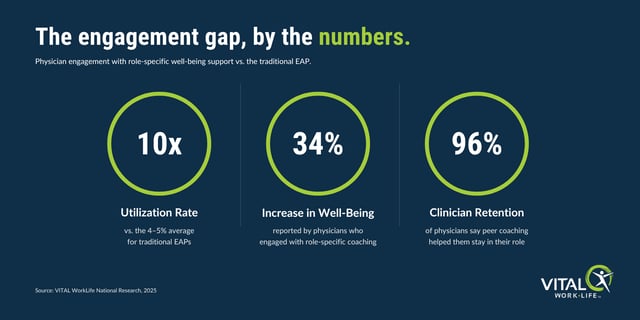
These numbers point to a structural problem, not a motivation problem. Physicians aren't avoiding support because they don't need it; they're avoiding a format that wasn't designed with their specific barriers in mind.
What This Looks Like in Practice
At Parkview Health, a 14-hospital system, leadership recognized that stigma and privacy concerns were keeping physicians from using existing mental health resources. As Dr. Michael Yurkanin, Chief Medical Officer at Parkview Health explained:
Parkview didn't eliminate their EAP. They added a physician-specific layer designed around anonymity, peer-level credibility, and leadership visibility without compromising individual confidentiality, closing the part of the gap the EAP alone couldn't reach.

Complement, Don't Replace
The question healthcare leaders should be asking isn't "do we have an EAP?" It's "is our EAP actually reaching our physicians?" With only 21% of clinicians agreeing that leadership has provided sufficient mental health resources — compared to 95% of leaders who believe they have — for most organizations, the honest answer is no.
Closing that gap doesn't mean starting over. It means adding a role-specific option that gets physicians engaging with the support that's already meant for them.
Get the Full Picture
This is one of five objections healthcare leaders commonly raise when clinician well-being programs come up for discussion — and one of the easiest to resolve once the data is on the table. We're exploring the other four in separate posts: cost, measuring ROI, "we don't have a burnout problem," and competing priorities.
The complete guide, Capture the Advantage: Your Journey Building a Thriving Culture of Well-Being, covers all five objections and the full strategic case for clinician well-being.