


Restoring Purpose and Performance in the Nurse Manager Pipeline
Most workplace well-being metrics ask a version of the same question: how bad are things? Burnout scores, stress checklists, and absenteeism rates are useful, but they all measure distress, telling you when something is wrong rather than when something is going right.
The Harvard Flourishing Measure (HFM) starts from a different question: is this person actually thriving? Not just getting by, not just free of crisis, but living with purpose, health, and connection. That's a meaningfully different thing to measure, and it changes what you can learn from the answer.
What the Harvard Flourishing Measure (HFM) Actually Is
The HFM was developed by Harvard's Human Flourishing Program, led by researcher Tyler VanderWeele, and published in the Proceedings of the National Academy of Sciences in 2017. It's a short, validated self-assessment: 12 questions, each scored on a 0–10 scale, built from measures that already had a track record in the well-being research literature. It's since been used in flourishing studies around the world, which means the questions aren't a proprietary invention. They're a shared, tested way of asking people how their life is actually going, and that shared foundation is part of what makes the results meaningful.
Six Domains, One Picture
The HFM organizes those 12 questions into six domains:
- Happiness & Life Satisfaction: your general sense that life is going well
- Mental & Physical Health: how you'd rate your health, in both senses, right now
- Meaning & Purpose: whether your day-to-day feels like it's going somewhere
- Character & Virtue: whether you're living in line with your own values
- Close Social Relationships: the quality of your connections, not just their number
- Financial & Material Stability: freedom from worry about meeting basic needs
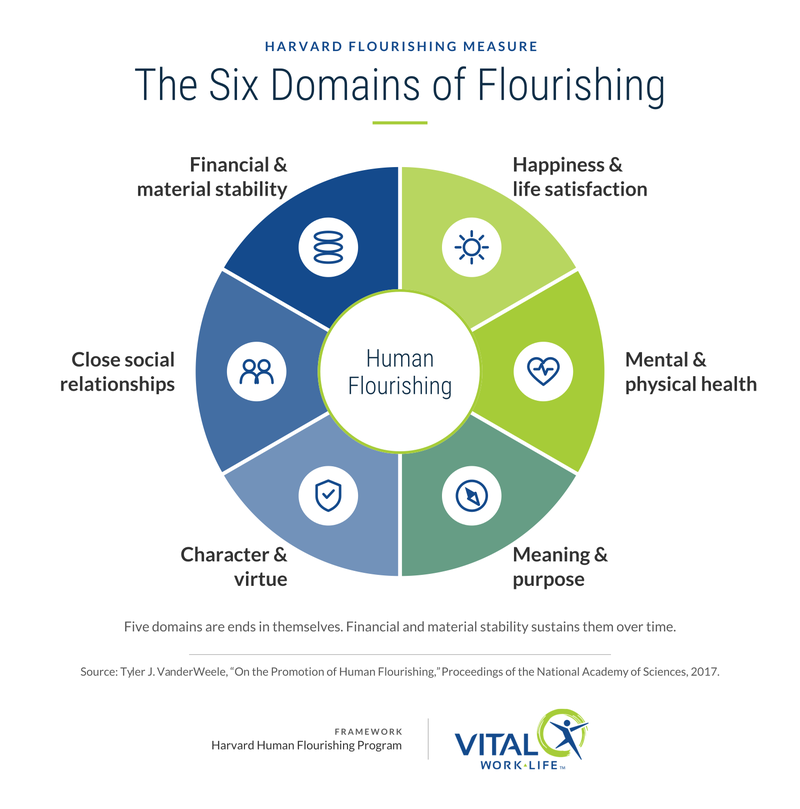
None of these six domains outranks the others in how the HFM measures them; every domain gets equal weight, and a high score in one can't make up for a low score somewhere else. That's deliberate: flourishing isn't a number you can max out by excelling in just one part of life.
One nuance worth knowing: Harvard's underlying research treats financial and material stability a little differently from the other five. It's still measured and still matters, especially since it's hard to feel settled elsewhere when you're worried about covering basic costs, but VanderWeele's original framework treats it more as a foundation that supports the other five than as an equal end in itself.
Why This Matters
If you're looking at well-being data for your workforce, most tools pick one lens, like engagement, satisfaction, or a symptom checklist, and call it well-being. The HFM resists that. It asks about health and money and relationships and meaning in the same breath, because that's closer to how people actually experience their own lives: not in silos, but as one interconnected whole.
It's also not built to sort people into "doing fine" or "struggling." There's no passing score. The Harvard researchers behind it are explicit about this: a score of 7 doesn't mean you've arrived, and a score of 4 doesn't mean you've failed. The number only means something next to your own previous number, and whether it's moving, and in which direction.
How We Use It
The HFM is the framework VITAL WorkLife uses to understand well-being across its programs. Not as a proxy for it, not one piece of a larger scorecard, but the actual lens we look through when we work with your organization. We administer it when someone on your team first reaches out for support, and again after they've engaged with services like coaching or counseling, which gives you two honest snapshots of the same population rather than a single guess at how your workforce is doing.
The Takeaway
Flourishing isn't a score to hit. It's a direction to keep moving in, one domain at a time, one honest self-assessment at a time. That's harder to put on a dashboard than a single well-being index, but it's a much truer picture of what it actually means for a person, or a workforce, to be doing well. It's the picture we're glad to be building toward.
Want to Go Deeper?
VITAL WorkLife partnered with the American Hospital Association on a webinar exploring exactly this, More Than Fine: Advancing Human Flourishing as a Strategic Value for Better Patient Care, featuring a case study from UnityPoint Clinic on closing the gap between good intentions and measurable impact at the bedside.
That gap, between saying well-being matters and proving it, is what this whole framework is built to close. It's worth a watch if you want to see it in action at the scale of a health system.