

Case Study: The ROI of Caring: How a Health System's Investment in Physician Well-Being Paid Off in Utilization and Retention
"We can't afford to invest in clinician well-being" is one of the most common objections healthcare leaders raise when these programs come up for budget discussion. In a climate of tightening margins and department-by-department scrutiny, it's an understandable instinct.
But it's the wrong question. The real question isn't whether you can afford to invest; it's whether you can afford not to.
The Reality: Inaction Has a Price Tag Too
Every dollar spent on clinician well-being gets scrutinized as a line-item expense. Meanwhile, the cost of burnout (turnover, lost productivity, medical errors) often goes unmeasured, even though it's already being paid.
Forward-thinking leaders don't treat investing in clinician well-being as a discretionary benefit. They treat it as risk mitigation with a measurable, calculable return.
The Cost of Inaction, By the Numbers
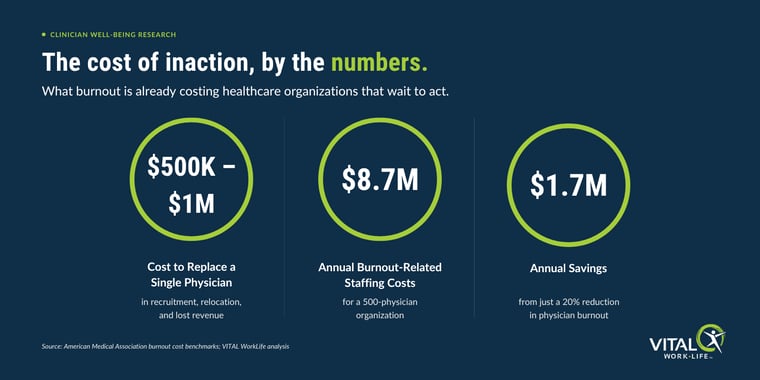
These aren't abstract industry averages; they scale directly with your organization's size and specialty mix. A 500-physician system isn't looking at a hypothetical $8.7 million; that's what national burnout and turnover benchmarks project it's already losing every year it doesn't act.
What This Looks Like in Practice
At Indiana University Health, leadership had to make this exact case internally — justifying an investment in clinician well-being against every other competing budget priority. As Emily Jerman-Brown, Vice President of Human Resources at Indiana University Health, put it:
Run Your Own Numbers
Indiana University Health's numbers made the case for their organization. But national averages and other organizations' case studies can only carry an internal budget conversation so far — the version that actually moves your leadership team uses your own headcount and specialty mix.

That number is usually all it takes to shift the conversation from "can we afford this?" to "can we afford to wait?"
The Real Math
That shift in framing matters because the other side of the ledger — turnover, reduced productivity, malpractice exposure, and the compounding cost of losing institutional knowledge every time a physician leaves — is already on the books, whether or not it shows up in this year's budget conversation.
Closing that gap doesn't require a bigger budget. It requires putting a number on what turnover and reduced productivity is already costing you.
Get the Full Picture
This is one of five objections healthcare leaders commonly raise when clinician well-being programs come up for discussion. Explore the rest of the series: we already have an EAP, measuring ROI, "we don't have a burnout problem," and competing priorities.
The complete guide, Capture the Advantage: Your Journey Building a Thriving Culture of Well-Being, covers all five objections and the full strategic case for clinician well-being.